Happy Birthday Decorative Element
A Designer’s First Look: Cheerful, Clean, and Ready for Stitching
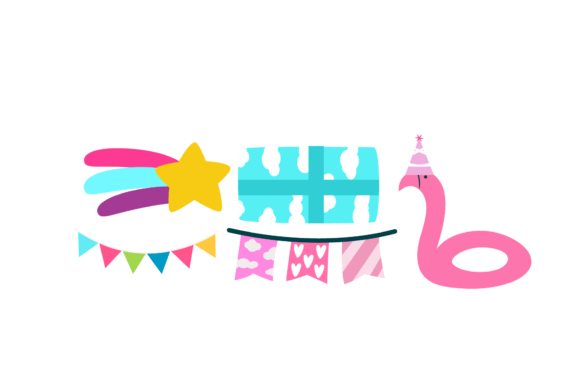
When I opened Happy Birthday Decorative Element, my first thought wasn’t “cute” — it was “usable.” As someone who’s stitched hundreds of birthday-themed pieces for clients (from baby onesies to boutique aprons), I immediately scanned the layout: balanced composition, clear letterforms, intentional negative space, and a decorative motif that supports — not overwhelms — the message. It reads as joyful without tipping into cluttered or juvenile. That’s rare in stock icons, especially in the Icons category. This isn’t just clipart dressed up; it feels like a considered Graphics asset built for real-world embroidery.
Real Project Test: A Custom Embroidered Tote Bag for a Local Bakery
Last week, I used Happy Birthday Decorative Element on a natural canvas tote for a neighborhood bakery’s “Birthday Bundle” promotion — think cake slices, candles, and handwritten tags. I placed it centered on the front panel, sized to 4.5 inches wide. The result? Crisp satin stitch edges held beautifully on medium-weight cotton duck, and the fill stitch areas stayed smooth without puckering. Customers noticed it right away — not just the words, but the gentle curve of the banner and the subtle decorative swirls. That tells me Happy Birthday Decorative Element works as both a functional label and a quiet brand enhancer. It doesn’t shout — it invites.
Where It Shines (and Where to Pause)
Happy Birthday Decorative Element excels in projects where clarity and charm matter more than complexity:
- Custom apparel: Sweatshirts, t-shirts, and lightweight jackets — especially when paired with minimal backing and light stabilizer.
- Embroidered patch applications: Great for iron-on or sew-on patches on denim jackets, backpacks, or kids’ caps.
- Baby embroidery: Works beautifully on onesies and burp cloths — soft curves read well at small scales, and the clean lines avoid visual noise.
- Holiday embroidery and gifting: Fits seamlessly into curated gift sets (think tea towel + mug + embroidered pillow cover).
- Craft business and Etsy seller use: Looks professional in digital mockups and translates cleanly to physical products — no last-minute redesigns needed.
But here’s where attention matters: on stretchy fabric (like ribbed knits), the outer curves may need extra stabilization to prevent distortion. On dark fabric, test your thread colors carefully — the design’s open spacing means contrast is critical for legibility. And if you’re planning a cap or curved surface, confirm your hoop size accommodates the full width comfortably — tight curves can compress fine details.
What You’ll Notice After Stitching
Unlike many generic birthday graphics, Happy Birthday Decorative Element holds up in the finished product. The lettering stays distinct, even after washing. The decorative accents — those little flourishes around the “H” and “Y” — don’t vanish into dense stitch density; they pop just enough to feel handmade, not machine-perfect. That balance elevates perceived value. A customer receiving a personalized gift with this design doesn’t think “stock file” — they think “thoughtfully made.” For a small shop product or handmade product, that impression builds trust and repeat orders.
Practical Notes Every Embroidery Designer Should Check
Before stitching your first piece, do these five things:
- Test on scrap fabric — especially if using textured fabric or layered garments like hoodies.
- Review stitch density in your embroidery software. If fill areas look overly heavy, adjust underlay or reduce density slightly.
- Confirm hoop size matches your intended placement — remember, the original canvas is 1920 px × 1280 px, but physical output depends entirely on your digitizing or conversion step.
- Inspect small details in black-and-white mockups. Does the “a” in “Happy” stay legible? Does the decorative element retain shape on thin fabric?
- Verify licensing. Since this is sold as a digital embroidery file across AI, EPS, SVG, JPG, and PNG formats, confirm whether commercial use — including selling finished embroidered items or using it in client work — is permitted. When in doubt, contact the seller directly.
Fabric & Finish Considerations
This design performs best on stable, medium-weight fabrics: cotton twill, linen blends, canvas, and mid-weight knits with good recovery. Avoid pairing it with ultra-thin silk or loosely woven gauze unless you add tear-away + cut-away stabilizer. On curved surfaces like caps, consider simplifying or repositioning decorative corners — the original layout assumes flat application. Also, if you’re building a personalized gift set (e.g., matching pillow cover + kitchen towel), keep thread color consistent across pieces — Happy Birthday Decorative Element’s open structure makes color-matching forgiving, but consistency reinforces brand cohesion.
Final Thought: A Quiet Workhorse, Not a Flashy Gimmick
I don’t reach for Happy Birthday Decorative Element when I need fireworks. I reach for it when I need reliability, warmth, and quiet professionalism — like embroidering a nursery wall hanging for a first birthday, or adding a custom touch to a local café’s staff apron line. It supports the moment instead of stealing it. That’s what makes it valuable for creative entrepreneurs, apparel decorators, and anyone who treats each embroidery project as a small act of care. It’s not just another machine embroidery design. It’s a tool that helps you say “happy” — clearly, kindly, and well-made.