Hand Drawn Blank Frame Border. Decorativ
A Soft, Sketchy Frame That Feels Like a Handmade Whisper
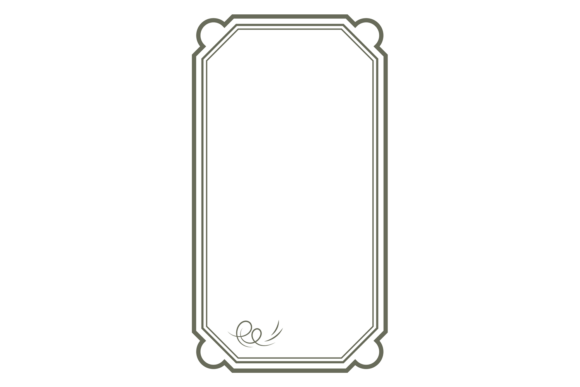
First glance at Hand Drawn Blank Frame Border. Decorativ is like spotting a quiet doodle in the margin of a well-loved sketchbook—loose, slightly uneven, full of gentle rhythm and intentional imperfection. It’s not symmetrical in the rigid sense; corners taper with organic asymmetry, lines vary subtly in weight, and the overall shape breathes like something drawn slowly, not plotted. This isn’t a crisp vector border for corporate branding—it’s an Illustrations asset built for warmth, personality, and handmade authenticity. As a designer who stitches daily for Etsy sellers and boutique clients, I immediately saw its home: on a linen tea towel folded over a kitchen counter, framing a tiny embroidered name on a baby onesie, or wrapping around a custom embroidered patch for a small shop apron.
Where It Shines—and Where It Needs Thoughtful Placement
I tested Hand Drawn Blank Frame Border. Decorativ on three real projects: a cotton tote bag (medium-weight canvas), a 100% cotton baby bodysuit, and a lightweight linen pillow cover. On the tote? Gorgeous. The frame sat cleanly, its open interior left space for a simple monogram or seasonal motif—no crowding, no visual noise. On the bodysuit? It worked beautifully when scaled to ~3.5" wide, but only with light stabilizer and careful hooping. The fine inner linework held up, though I avoided stitching it directly over seams or curved shoulder seams where tension distorts stitch clarity.
It’s a natural fit for custom apparel, especially sweatshirt embroidery where softness matters more than sharpness. On dark fabric, the design reads best with high-contrast thread—navy thread on cream, charcoal on oat, or even metallic gold on deep burgundy. But on very textured fabrics (like bouclé or thick terry cloth), the delicate outer strokes can blur unless you reduce stitch density slightly or add a tear-away + cut-away stabilizer combo.
What Real Customers Notice—Before They Even Read the Label
Here’s what stood out during client feedback: people *touched* the finished items first. Not because they were confused—but because the frame’s hand-drawn quality invites tactile engagement. One Etsy buyer wrote, “It feels like someone sat down and drew this just for me.” That emotional resonance lifts perceived value. A $28 embroidered pillow cover with Hand Drawn Blank Frame Border. Decorativ framed around a botanical motif sold faster than identical versions with geometric borders. Why? Because it signals care, individuality, and intention—not mass production.
That said, it doesn’t suit every product. Skip it for dense commercial embroidery runs on performance wear—its looseness clashes with technical fabric expectations. And avoid using it as the sole focal point on small hoop sizes (under 3") unless you’re willing to simplify corners manually. Tiny flourishes near the frame’s inner edge can vanish into fill stitch or get lost in thread nesting.
Smart Embroidery Designer Notes You’ll Actually Use
- Always test on scrap fabric first—especially if your project uses stretchy knit or thin voile. The frame’s open structure means stabilizer choice affects line definition more than usual.
- Check thread color contrast early. Light gray thread on off-white linen looks elegant; pale yellow on ecru can disappear. Try black-and-white mockups before finalizing palettes.
- Review stitch density in your embroidery software. If the file includes satin-stitched edges or tight fill areas in corners, dial back density by 5–10% on lightweight fabrics to prevent puckering.
- Confirm hoop size compatibility. While the design scales well, extreme resizing (below 2.75" or above 6.5") may require manual cleanup of stitch jumps or corner joins.
- Inspect small details at 200% zoom—not just on screen, but stitched. Tiny loops or tapered ends should land cleanly, not float or pull.
- Use proper stabilizer: medium-weight cut-away for knits, tear-away for stable wovens, and a light film topping for shiny fabrics to keep lines crisp.
- Verify licensing before selling finished products or bundling Hand Drawn Blank Frame Border. Decorativ into digital embroidery kits. As a Graphics asset, its permitted use varies—some licenses allow commercial embroidery but restrict resale of the digital file itself.
Not Just a Border—A Quiet Signature for Your Brand
This isn’t filler. It’s a subtle signature—ideal for craft businesses that want consistency without repetition. Imagine using it across holiday embroidery (framing a tiny snowflake on a stocking), baby embroidery (encircling a single initial on a bib), or personalized gifts (wrapping a date on a wedding kitchen towel). It builds brand recognition not through logos, but through recurring warmth—a visual “handshake” your customers recognize across product categories.
For Etsy sellers and small shop owners, it’s also a smart time-saver: no need to draft frames from scratch for each listing. Pair it with clean fonts or minimalist motifs, and you’ve got cohesive, professional-looking digital embroidery file bundles. Just remember—its strength lies in restraint. Let it frame, not compete. Keep interiors minimal. Trust the sketchy line to do the talking.
Final Thought: It’s Not About Perfection—It’s About Presence
In a market flooded with ultra-polished, algorithm-optimized designs, Hand Drawn Blank Frame Border. Decorativ stands out by refusing to shout. It works because it feels human—not generated, not generic, not rushed. When stitched thoughtfully, it elevates a simple embroidered patch into a keepsake, turns a plain tote bag design into a curated object, and gives a handmade product the quiet confidence of something made with attention. Use it where softness matters more than symmetry—and where your customer values the feeling of being seen, not just served.